-
Title
-
Golspie to Eastwood (1856)
-
Description
-
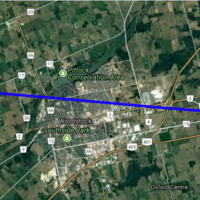
Strong significant tornado witnessed by many locals as it tracked through the area. Detailed description of storm progression and tornado in newspaper. Noted to have sounded like Niagara Falls. Many people attempted to shelter as it approached, most avoiding serious injury or death, while others unfortunately were caught in the midst of the violence, and were either seriously injured or killed. At least 4 people lost their lives, making it the 3rd (?) deadliest Canadian tornado up to that point in time. Track Length: “10mi†UTM~13.5km, Direction: ~275° (W-E), Injuries: “at least 11â€, Deaths: “4, one other not expected to live†“cattle, 20 sheep, dog, fowlâ€, Damage Cost: Likely thousands of dollars at the time.
-
Publisher
-
NTP Archives
-
Date
-
1856-06-29
-
Time (Local)
-
14:30
-
County
-
Oxford
-
Province
-
Ontario
-
Country
-
Canada
-
Fujita Rating
-
F3
-
Classification
-
Confirmed
-
Track Length
-
13.5
-
Direction
-
W - E
-
Shape
-
“When we first caught sight of it, it appeared to the eye like a dense spiral column of very black smoke, proceeding as it might be, from some vast furnace, and ascending with a twirl of lightning-like rapidity to the perpendicular, a little inclined though, at times, towards the direction of the course. It was moving in, until it lost or spent itself in the heavy clouds above. From this description it sometimes varied, widening considerably at its point of contact with the earth, and at other times almost disappearing. When this huge pillar of smoke had approached out point of observation near enough, we could faintly discern objects floating about in the air above it, and being whirled in every direction. These at first seemed smaller, but as the storm approached nearer and nearer we were at length able to see large branches of trees, whole tree tops, also of large dimensions, and a countless number of other things the description of which it was impossible to conjecture. At times also, a continual murmuring noise, like distant thunder, could be heard proceeding from the direction of the pillar, amidst which at its nearest point to us, from half to three quarters of a mile, might also be heard, like shrieks of the wounded in battle, the crash of the giant forest trees, as they were plucked from their foundations and thrown down or tossed about with such apparent ease, by the invisible hand of the “Storm-Kingâ€, or as their heads were torn from their trunks, and flung in glorious glee high up in the sportive air, with the lightness of feathers. The fierceness of the storm at this time was truly awful. The dense forest in front of the pillar of smoke through which the eye could not penetrate the least, as it passed along, land opened and the sky beyond left plainly visible.†– The Weekly Globe Toronto, Friday, July 4th, 1856 (From The Woodstock Gazette)
-
Injuries
-
11
-
Deaths
-
4
-
Damage Type
-
One brick house completely destroyed. Several other frame buildings levelled. Many roofs removed from structures, and other partial destruction to various buildings. One train car blown off the tracks. Loose materials such as boards carried significant distances, some as far as 20km away in Paris. Extensive tree damage – many large trees ripped out of the ground and carried through the air hundreds of meters. Swaths of bushland flattened.